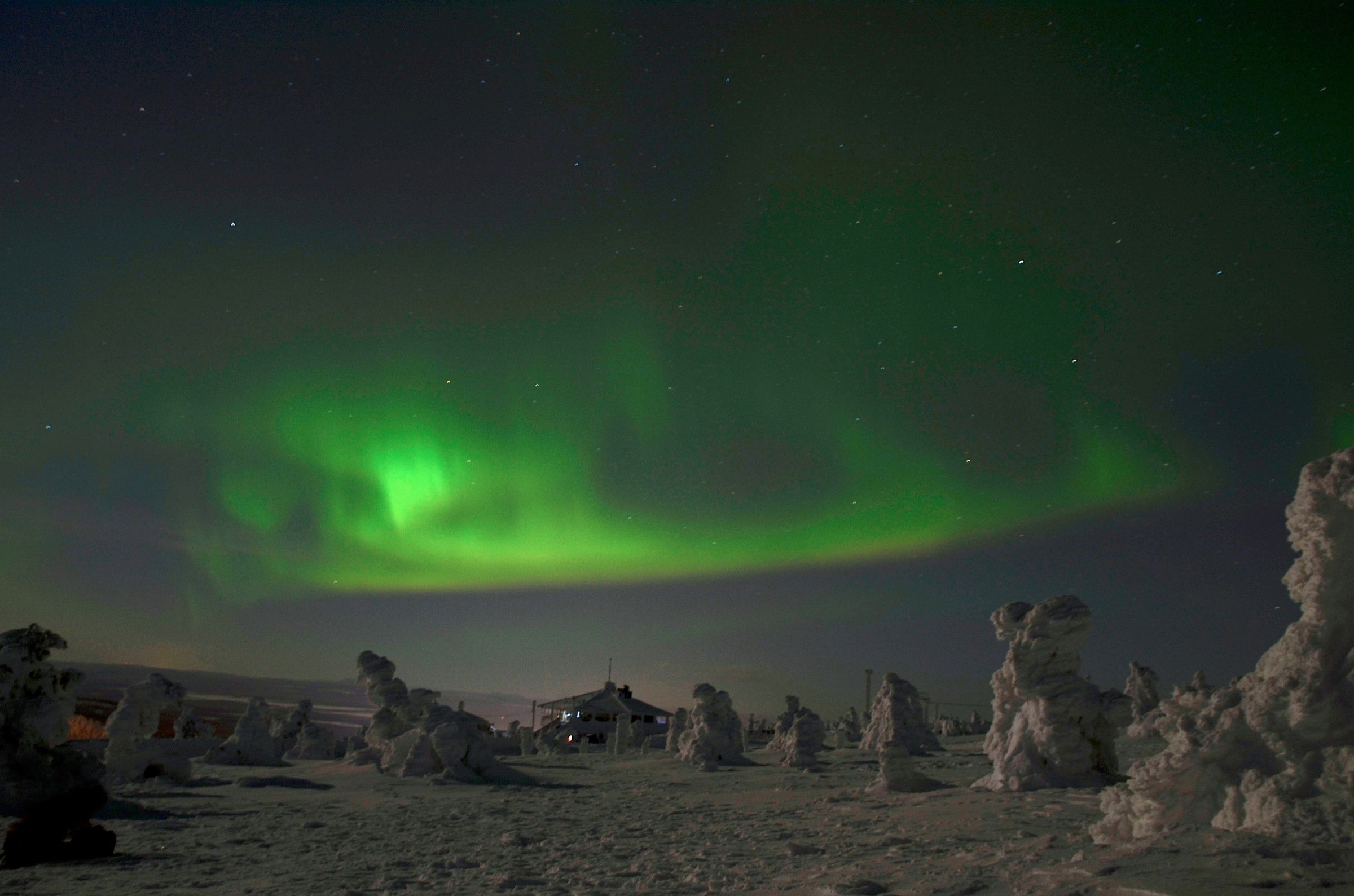
You don’t need a tour to see the aurora. You do need darkness, a clear sky, warm clothes and patience. A tour sells you those last three, plus transport and local knowledge. Whether that’s worth it depends on where you stay and how you travel.
Going on your own
Works best when:
- you stay outside a town centre, in a cabin, a resort on the edge of the forest, or a glass igloo;
- you can walk a few minutes to a dark, open spot with a view north;
- you are flexible enough to go out when the sky clears.
Advantages: free; no fixed schedule; you can go out the moment the sky clears, and stay as long as you like.
Disadvantages: you can’t move to a clearer area without a car; waiting outside in the cold is harder without a warm shelter; city lights in Rovaniemi or Ivalo centre make faint displays hard to see.
How to do it:
- Check the cloud forecast in the afternoon and the aurora activity in the evening (links on On the trip).
- Go out between 9 p.m. to 1 a.m. and look north.
- Take a thermos, a headlamp with a red light setting, spare batteries for your phone (cold drains them fast) and a seat pad.
Guided aurora tours
Tours differ a lot. Common types:
- Aurora chasing by minibus. The guide checks forecasts and drives to where the sky is clearest. Best odds when the weather is mixed.
- Fixed-camp tours. A walk, snowshoe hike or snowmobile ride to a camp with a fire and hot drinks, then you wait there. Cosy, but you see the aurora only if that spot is clear.
- Photography tours. Small groups, the guide helps with camera settings and takes portraits of you under the aurora.
- Snowmobile or reindeer sleigh aurora safaris. More of an experience than a search; good if you’d do the activity anyway.
Advantages: no winter driving; warm clothing often provided (check); local knowledge of dark spots; cloud-chasing; photos.
Disadvantages: costs money; fixed departure time; if the night is clear anyway, you might have seen the same display from your hotel.
Before you book, check: whether the tour chases clear skies or stays at one spot; group size; whether warm overalls and boots are included; the cancellation or rebooking policy for bad weather; and whether any “aurora guarantee” is a refund, a free retry, or just a photo.
Our recommendation
- Based in Rovaniemi or another town: book a chasing tour early in the trip. Use the free nights to look for yourself from a darker spot.
- Staying in a cabin, igloo or resort in northern Lapland: go on your own most nights; add one guided night for photos or a snowmobile or reindeer trip.
- Never driven on snow and ice: don’t start on a dark, icy night just to chase the aurora. Take a tour.
Safety in the cold and dark
- Never stop on a road or its shoulder to watch or photograph the aurora. Use proper parking areas. Check road conditions before any winter drive.
- Stay off frozen lakes and rivers unless a guide says the ice is safe.
- Dress for standing still. Watching the aurora means waiting, not moving; layers, a warm hat, mittens and winter boots matter more than on a walk.
- Tell someone where you are going if you leave the resort area, and keep your phone warm in an inside pocket.
- Emergency number in Finland: 112.
Related
Questions
Is an aurora tour worth it?
It is if you stay in a town, don't drive in winter, or want a guide to chase clear skies. If you stay somewhere dark, watching on your own costs nothing.
What kind of aurora tour is best?
A tour that moves with the weather to find clear skies is usually better than one that waits at a fixed spot.
Can I combine a tour and watching on my own?
Yes. Many travellers book one guided night early, then use the other nights on their own.
Facts on this page
Every number on this page comes from the source below and was checked on the date shown.
| Fact | Value | Source | Checked |
|---|---|---|---|
| Best time of night to see auroras (local time) | 9 p.m. to 1 a.m. | en.ilmatieteenlaitos.fi |