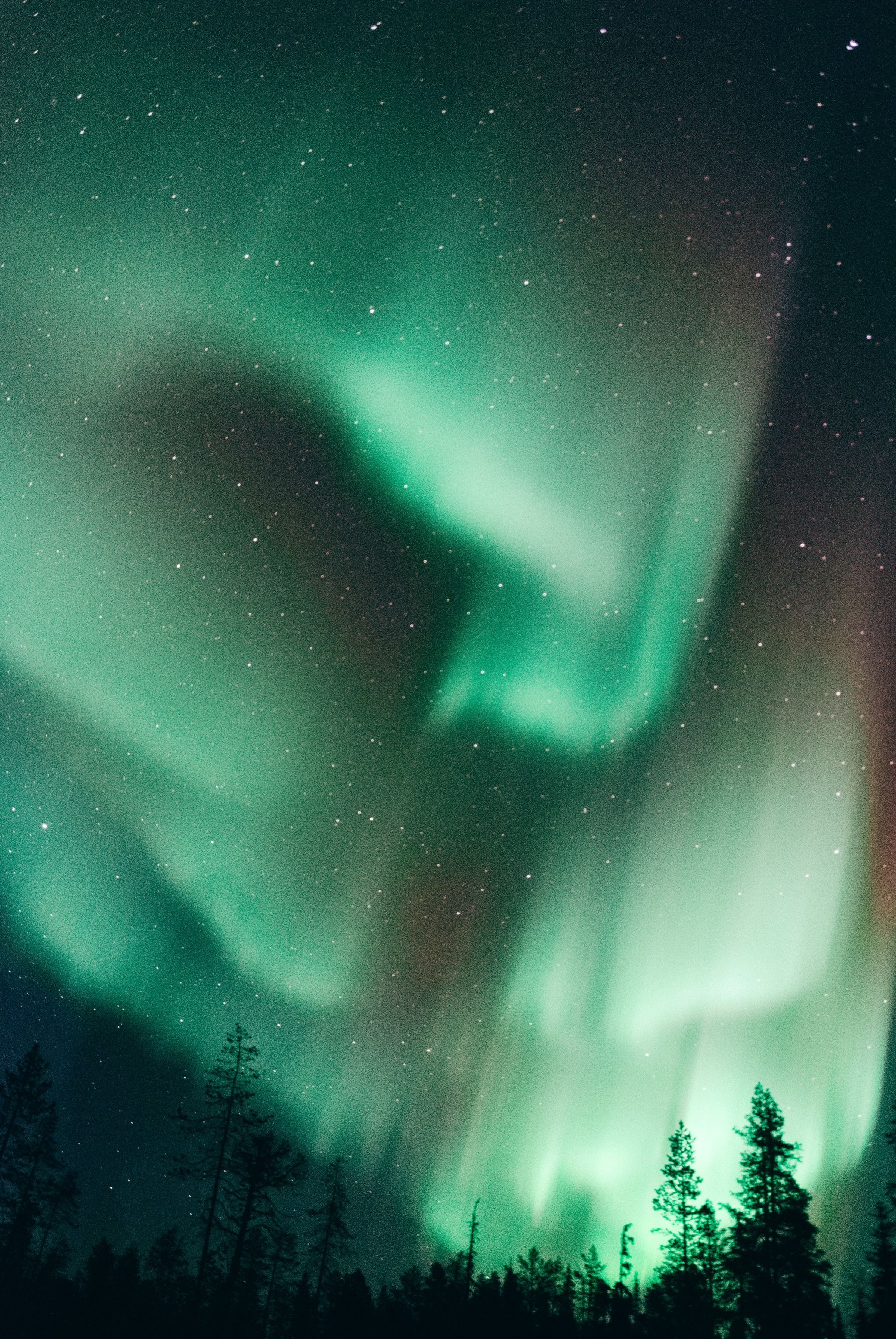
The northern lights are the main reason most people come to Lapland in winter, and the main source of disappointment for those who leave without seeing them. The good news: Finnish Lapland is one of the most reliable places in the world for the aurora. The honest news: nobody can guarantee a display on a particular night.
This guide uses the statistics of the Finnish Meteorological Institute (FMI) so you can plan with real numbers, not marketing.
When is aurora season?
In Finnish Lapland the season runs from late August to early April. Auroras happen all year, but in summer the nights are too light to see them.
Within the season, FMI names September–October and February–March as the best months for activity. When the weather is also taken into account, FMI says the best time in northern Finland is March and early April. Spring also brings deep snow and longer days for activities between aurora nights.
December and January have the longest nights (see kaamos), yet FMI’s weather-adjusted advice still points to spring. Long nights help; clear skies help more.
Where in Finland are the odds best?
The further north you go, the more often the aurora appears overhead. FMI gives these probabilities for seeing auroras on a dark, cloudless night:
| Place | Chance on a dark, clear night |
|---|---|
| Kilpisjärvi (far north-west) | about 75% of nights |
| Sodankylä (central Lapland) | every second night |
| Lapland ski resorts: Levi, Ylläs, Saariselkä | roughly 50% of nights |
| Central Finland: Oulu, Kuusamo | roughly 25% of nights |
| South coast: Helsinki, Turku | about once a month |
Two things to notice:
- “Dark and cloudless” is the condition. These numbers say nothing about how often the sky is clear. Clouds are the reason most visitors miss the aurora.
- Rovaniemi is not in FMI’s list. It lies south of Sodankylä and the resorts, so expect lower odds than there, and you need to get away from the city lights.
If seeing the aurora is the main goal of your trip, base yourself in northern Lapland (Saariselkä, Inari, Levi, Ylläs or Kilpisjärvi), not only in Rovaniemi. Our comparison of Rovaniemi, Levi and Saariselkä helps you choose.
What time of night?
FMI’s best window is 9 p.m. to 1 a.m. local time. Displays can happen earlier or later, and strong ones can last minutes or hours. Dress warmly enough to wait outside, and check the sky every 20–30 minutes if you are indoors.
How to read the forecast
You will see two kinds of forecast. Use both.
- Aurora activity. The Kp index runs from 0 to 9. In northern Lapland, Visit Finland notes that a reading of 1–2 might already be enough. A higher Kp does not help if it is cloudy. FMI publishes live activity for Finland (links on our On the trip page).
- Clouds. This decides your night. Check the hourly cloud forecast for your town, and look for gaps. A short drive or a guided “aurora chase” to a clearer area often makes the difference. Step by step: how to read the aurora forecast.
Tip: long-range aurora forecasts are unreliable. Don’t plan your trip around a forecast weeks ahead. Plan enough nights instead: see how many nights you need.
Where to watch from
- Get away from lights. Street lights and hotel lights wash out faint displays. Even a few hundred metres into the dark helps.
- Face north, with an open view: a frozen lake, an open fell top or a field.
- Let your eyes adapt for 10–15 minutes and avoid looking at your phone screen.
- Faint auroras look grey-white to the eye and green on camera. Take a test photo if you’re unsure.
Safety: never stop on the road or the road shoulder to watch the aurora, and stay off lakes and rivers unless you know the ice is safe (on a tour, follow the guide). Temperatures at night can be far below zero: wear proper layers and boots even for a “quick look”.
Tour or on your own?
Both work. A guided tour handles the driving, the cold and the cloud-chasing; going on your own is cheaper and more flexible. We compare them in aurora tours vs going on your own.
Questions
Can you see the northern lights in Finland in December?
Yes. December is in the aurora season and the nights are longest, but it is also often cloudy. Plan several nights and check the cloud forecast each evening.
Is Rovaniemi or the far north better for the aurora?
Both work. The far north (Saariselkä, Inari, Kilpisjärvi) has darker skies and slightly higher odds; in Rovaniemi you need to get away from the city lights.
Do I need a tour to see the aurora?
No. If you stay somewhere dark you can watch on your own. A tour helps if you are in a town, don't drive in winter, or want to chase clear skies.
Facts on this page
Every number on this page comes from the source below and was checked on the date shown.
| Fact | Value | Source | Checked |
|---|---|---|---|
| Aurora viewing season in Finnish Lapland | late August to early April | visitfinland.com | |
| Probability of auroras on a dark, cloudless night at Kilpisjärvi | about 75% of nights | en.ilmatieteenlaitos.fi | |
| Probability on a dark, cloudless night in Lapland ski resorts (Ylläs, Levi, Saariselkä) | roughly 50% of nights | en.ilmatieteenlaitos.fi | |
| Aurora nights in Sodankylä (clear skies) | every second night | en.ilmatieteenlaitos.fi | |
| Probability on a dark, cloudless night in central Finland (Oulu, Kuusamo) | roughly 25% of nights | en.ilmatieteenlaitos.fi | |
| Aurora frequency on the south coast (Helsinki, Turku) | about once a month | en.ilmatieteenlaitos.fi | |
| Best time of night to see auroras (local time) | 9 p.m. to 1 a.m. | en.ilmatieteenlaitos.fi | |
| Best months for auroras (activity) | September–October and February–March | en.ilmatieteenlaitos.fi | |
| Best time in northern Finland when weather is also considered (FMI) | March and early April | en.ilmatieteenlaitos.fi | |
| Kp index that may be enough for auroras in northern Lapland | 1–2 | visitfinland.com |